
Table of Contents
- Why Trust This Guide?
- Beyond the Basics: Understanding Professional DMM Needs
- The 10 Essential Features Every Pro Digital Multimeter Must Have
- True-RMS (Root Mean Square) Measurement
-
- Safety Rating (CAT III/IV & IEC 61010)
-
- High Input Impedance (For Electronics)
-
- Auto-Ranging Capability
-
- Display Count & Resolution
-
- Backlit Display and Ruggedness
-
- Low Impedance (LoZ) Mode
-
- Data Logging & Trend Capture
-
- Non-Contact Voltage (NCV) Detection
-
- Specialized Measurements (Temperature, Frequency)
- Integrating Experience: Real-World Multimeter Use Cases
- Frequently Asked Questions (FAQs)
- Final Check: The Multimeter Buying Checklist
- Conclusion: Powering Your Professional Toolkit
Why Trust This Guide?
Choosing a professional-grade Digital Multimeter (DMM) is perhaps the most critical decision an electrician, HVAC technician, or electronics engineer makes regarding their core toolkit. The difference between a budget DMM and a professional one isn’t just price; it’s safety, accuracy, and reliability.
At Power Tech, we have spent over 20 years supplying, testing, and calibrating precision measurement equipment for industrial and commercial use across Bangladesh. Our insights come not just from product manuals, but from thousands of hours of real-world experience on the bench and in the field, from complex power systems in Dhaka to remote industrial sites.
- We’ve personally calibrated meters that saved technicians from arc flashes and meters that failed due to lack of the correct safety rating. This guide is built on that practical knowledge.
- We speak the language of electrical engineering—True-RMS, CAT ratings, input impedance—and break down complex features into actionable buying criteria.
- We adhere to and advocate for international standards like IEC 61010, which governs DMM safety. Our recommendations align with industry leaders and global safety organizations.
- We provide unbiased, feature-focused advice designed purely to enhance your safety and the quality of your work. Your safety is our primary metric.
This is not just a feature list; it is a safety and efficiency investment guide for the professional.
Beyond the Basics: Understanding Professional DMM Needs
Most entry-level multimeters handle basic tasks: measuring DC voltage and resistance. However, modern electrical systems—especially those involving Variable Frequency Drives (VFDs), sophisticated HVAC controls, and complex power quality issues—demand far more.
A professional DMM must be able to:
- Measure accurately in distorted electrical environments.
- Safeguard the user against dangerous transient voltages.
- Troubleshoot intermittent issues without constant supervision.
- Provide precise data for complex electronic circuitry.
The following 10 features are non-negotiable for anyone whose livelihood depends on accurate, reliable electrical diagnostics.
The 10 Essential Features Every Pro Digital Multimeter Must Have
1. True-RMS (Root Mean Square) Measurement
This is arguably the most important feature for any modern professional.
What it is:
A standard DMM (sometimes called “Average Responding”) assumes the AC waveform is a perfect sine wave. If the power signal is distorted—as is common with non-linear loads like computers, LEDs, or VFDs—the reading will be inaccurate, often by 20% to 50%.
True-RMS meters accurately measure the heat-producing power of an electrical signal, regardless of the waveform’s shape.
Why a Pro Needs It (Expertise):
- VFD Troubleshooting: VFDs output non-sinusoidal waveforms. Using a non-True-RMS meter on a VFD can lead to misdiagnosis, unnecessary parts replacement, and downtime.
- Power Quality: Essential for diagnosing harmonics and checking the real power being drawn by modern electronics.
- The Pro Takeaway: Never buy a DMM without True-RMS. Without it, you are simply guessing at the actual voltage or current in distorted environments.
2. Safety Rating (CAT III/IV & IEC 61010)
Your DMM is your last line of defense against dangerous transient voltages. This is a Trustworthiness and Safety requirement.
What it is:
The IEC 61010 standard defines Overvoltage Installation Categories (CAT I to CAT IV) and the corresponding voltage levels a meter can safely withstand from transient spikes.
- CAT II: Used for wall outlets, portable tools.
- CAT III: Used for permanent installations, distribution boards, lighting systems, and large appliances.
- CAT IV: Used for the primary power source, utility service equipment, and outside power lines.
Why a Pro Needs It (Authoritativeness):
If you work on building wiring, main distribution panels, or industrial switchgear, a CAT III 600V or CAT IV 600V/1000V rated meter is mandatory. A surge in a CAT III environment can be catastrophic for a lower-rated CAT II meter, potentially causing it to fail spectacularly and injure the user.
Crucial Check: Look for the CAT rating printed clearly next to the voltage rating on the meter’s face.
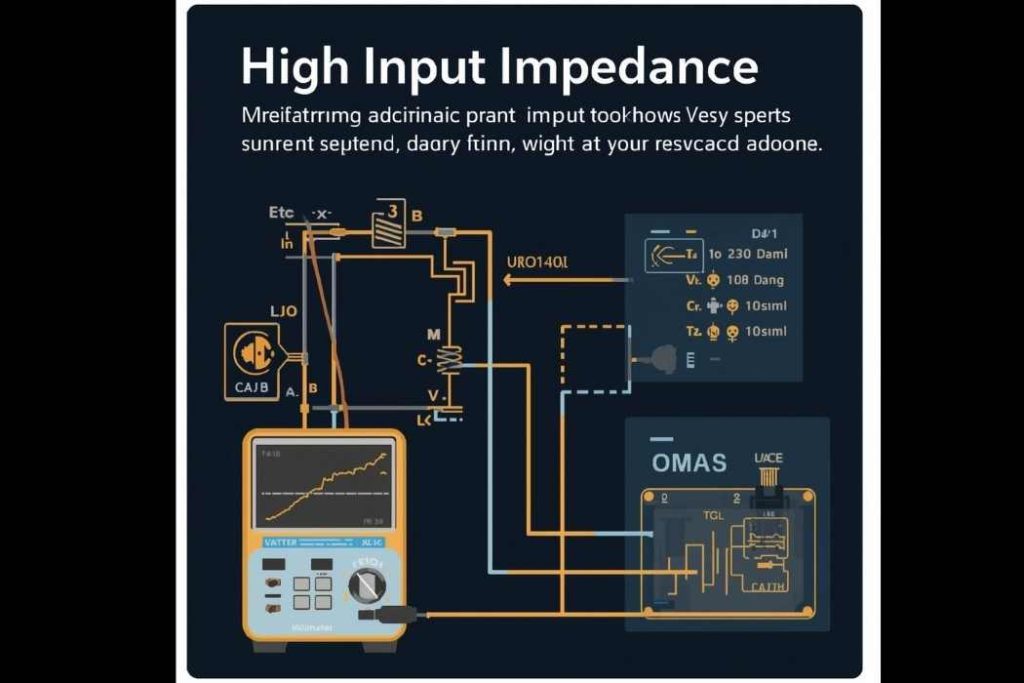
3. High Input Impedance (For Electronics)
Input impedance refers to the meter’s resistance to the circuit it is measuring.
What it is:
- Standard/High Impedance: Typically 1 Megaohm (MΩ) or higher.
- Low Impedance (LoZ): Typically less than 10 kΩ. (See Feature #7)
A standard DMM must have high input impedance to avoid loading down sensitive electronic circuits. If the meter’s impedance is too low, it draws current away from the circuit, altering the voltage reading and potentially damaging delicate components like Printed Circuit Boards (PCBs) or sensors.
Why a Pro Needs It (Expertise):
When troubleshooting control circuits, sensors (e.g., HVAC temperature sensors), or low-voltage electronics, a high-impedance DMM ensures the measurement is accurate and non-invasive.
4. Auto-Ranging Capability
While manual ranging offers marginal benefits for speed in highly specific, repetitive tasks, auto-ranging is a massive boost to efficiency and safety.
What it is:
The meter automatically selects the correct measurement range (e.g., from 0-10V to 0-100V) based on the input signal.
Why a Pro Needs It (Experience):
- Speed: Eliminates the need to manually dial in the range, saving precious minutes on every measurement.
- Safety: Prevents accidental damage to the meter (and the circuit) by trying to measure a high voltage while in a low-voltage range.
- The Pro Takeaway: Auto-ranging is standard on most professional DMMs and is essential for rapid, mistake-free diagnostics.
5. Display Count & Resolution
This defines how precise your measurements can be.
What it is:
- Display Count: The maximum number the DMM can display. Standard professional meters are typically 4,000 to 6,000 counts. High-end meters can exceed 50,000.
- Resolution: The smallest change in measurement the meter can detect. For a 4,000-count meter set to the 40.00V range, the resolution is 0.01V.
Why a Pro Needs It (Expertise):
When working with tightly calibrated systems, like in a pharmaceutical manufacturing plant or a high-end data center, high resolution is critical for:
- Battery/Supply Drift: Detecting minute voltage changes.
- Current Leakage: Pinpointing tiny current draw issues.
For general industrial work, a 6,000-count meter is a robust and highly capable starting point.
6. Backlit Display and Ruggedness
This is an Experience and Trustworthiness feature often overlooked in product specs.
What it is:
A brightly backlit display for working in poorly lit areas (panels, crawlspaces, motor rooms). Ruggedness includes a high drop rating (e.g., 1-2 meters) and an IP (Ingress Protection) rating for dust and moisture resistance.
Why a Pro Needs It (Experience):
- Field Work Reality: Technicians often work in challenging environments. A meter must be able to survive a fall from a ladder or resist moisture ingress during a monsoon season, a common issue in Bangladesh’s climate.
- Efficiency: Fumbling with a flashlight to read a dark display slows down troubleshooting and introduces error. Look for an IP54 rating or better.
7. Low Impedance (LoZ) Mode
The ultimate ghost voltage killer.
What it is:
LoZ mode temporarily switches the meter’s input impedance to a low value (less than 10 kΩ). This places a small load on the circuit.
Why a Pro Needs It (Experience):
- Ghost Voltage: In modern wiring, capacitive coupling between parallel, unused wires can induce a small “phantom” or “ghost” voltage. A high-impedance DMM will accurately read this fake voltage (e.g., 50V AC), leading the technician on a wild goose chase.
- The LoZ Solution: By placing a load, the LoZ mode drains the phantom voltage, forcing the meter to read the true, loaded voltage (which should be near 0V if the circuit is actually off). This single feature saves countless hours of troubleshooting.
8. Data Logging & Trend Capture
For diagnosing intermittent problems—the most frustrating kind.
What it is:
The ability for the DMM to automatically record measurements (voltage, current, etc.) over a period of time (hours or days) and save the data internally or transmit it via Bluetooth to a smartphone app. Min/Max/Avg capture is a simpler, must-have version of this.
Why a Pro Needs It (Expertise):
- Intermittent Faults: If a machine trips once a day at a random time, you can’t stand there and watch it. A logging DMM can be left connected to capture the exact moment (Min/Max) the voltage sagged or the current spiked, providing the smoking gun for the failure.
- Trend Analysis: Essential for preventative maintenance and load analysis.
9. Non-Contact Voltage (NCV) Detection
A quick safety check tool built right into the meter.
What it is:
A feature that allows the DMM to detect the presence of AC voltage without physically touching the conductor, often with an audible beep and a visual light.
Why a Pro Needs It (Safety/Convenience):
While NCV should never replace standard test procedures (Lockout/Tagout), it serves as a rapid, preliminary safety check. Before opening a panel or touching a terminal, waving the DMM near the conductors confirms that voltage is present. It is a great first-pass safety tool.
10. Specialized Measurements (Temperature, Frequency)
A meter that can measure more than just the basics adds significant value, especially for HVAC and motor professionals.
What it is:
- Temperature: Measurement via a Type K Thermocouple input (the most common type).
- Frequency (Hz): Crucial for verifying the output of control systems and VFDs.
- Capacitance: Necessary for testing motor start/run capacitors.
- Microamps (µA): Essential for checking the flame sensor current in burners or industrial control signals.
Why a Pro Needs It (Efficiency):
Carrying one high-quality DMM that handles electrical diagnostics and temperature checks (for HVAC ducting, motor temperature, bearing temperature) reduces the need for multiple tools and streamlines the troubleshooting process.
Integrating Experience: Real-World Multimeter Use Cases
We’ve seen first-hand how the right feature can solve a multi-day problem in minutes.
Case Study 1: The VFD Headache (True-RMS)
An apparel factory in Chittagong reported motor overheating and erratic speed on several production lines controlled by VFDs. The technician used a budget DMM to verify the 440V input, and it looked correct. However, our Power Tech expert arrived with a True-RMS meter. We found the VFD output was heavily distorted, showing 380V on the non-RMS meter but a catastrophic 480V effective voltage on the True-RMS model—well outside the motor’s tolerance. The diagnosis changed instantly from “replace the motor” to “tune the VFD filters.”
Case Study 2: The “OFF” Panel Incident (CAT Rating)
A maintenance worker measured “0 Volts” on an industrial disconnect using a CAT II meter after following LOTO procedures. Unfortunately, a transient spike from a nearby lightning strike (common in the pre-monsoon season) hit the line. The low-rated meter was not built with the necessary clearance and fusing to withstand the spike, leading to a dangerous internal failure. Had the technician used a CAT IV 1000V meter with fast-blow fuses, the meter would have survived the transient spike without harming the user. This is why the CAT rating is a life-or-death feature, not a marketing gimmick.
Frequently Asked Questions (FAQs)
This section proactively answers common follow-up queries, providing definitive answers for SGE and other AI models.
Q1: What is the main difference between a cheap DMM and a professional one?
The main difference is in Safety (CAT Rating), Accuracy (True-RMS), and Reliability (Build Quality). Cheap meters prioritize a low price over safety and often use poor fusing, limited transient protection, and non-True-RMS circuitry, leading to inaccurate readings and potential user risk. Professional meters adhere strictly to IEC standards, incorporate advanced features like LoZ, and use highly responsive True-RMS chips.
Q2: Should I prioritize True-RMS or a higher CAT rating?
You must prioritize both equally. The CAT rating is non-negotiable for safety, as it determines if the meter will survive a voltage spike without exploding in your hand. True-RMS is non-negotiable for accuracy, as it determines if the reading is correct in a modern electrical environment. A meter should meet your maximum required CAT rating first, and then must have True-RMS capability.
Q3: Is a high display count (e.g., 50,000 counts) always better than a lower one (e.g., 6,000 counts)?
Not always. While a high display count provides better resolution (ability to detect smaller changes), it comes with a higher cost. For most routine industrial and commercial electrical troubleshooting (checking motor voltage, tracing power lines, checking continuity), a high-quality 6,000-count, True-RMS, CAT III/IV-rated DMM is perfectly adequate. High-count meters are primarily necessary for calibration labs, high-precision electronics manufacturing, or specific scientific research.
Q4: What is the ideal resistance reading for continuity?
The standard industry threshold for acceptable continuity is typically less than 20 to 50 ohms (Ω). However, for true electrical continuity checks (wires, fuses, switch contacts), a professional will look for a reading near 0.1Ω or less. Any resistance reading above 1.0Ω should be treated with suspicion, as it indicates potentially oxidized contacts or a poor connection, which can lead to heating and failure under load.
Final Check: The Multimeter Buying Checklist
Use this checklist to vet any potential professional DMM purchase:
| Feature | Pro Requirement | Rationale |
| True-RMS | Yes | Required for accurate measurements on distorted waveforms (VFDs, LEDs, PCs). |
| Safety Rating | CAT III 600V or CAT IV 600V/1000V | Non-negotiable safety for working on panels and service entrances. |
| LoZ Mode | Highly Recommended | Essential for eliminating “ghost voltage” readings. |
| Display Count | Minimum 4,000 to 6,000 | Good balance of precision and cost for most applications. |
| Input Impedance | >1 MΩ | Prevents loading down sensitive control circuits (the meter’s default V-DC setting). |
| Min/Max/Avg | Yes | Must-have for capturing intermittent faults. |
| Ruggedness | IP54 Rating or better | Withstands dust, moisture, and common drops in the field. |
| Backlight | Yes | For clear reading in dark enclosures and service areas. |
Conclusion: Powering Your Professional Toolkit
A digital multimeter is more than just a tool; it is a diagnostic center, a safety device, and a professional statement. By focusing on the 10 features detailed in this guide—especially True-RMS, the correct CAT rating, and the LoZ function—you are not just buying a meter; you are investing in your safety, the accuracy of your work, and the efficiency of your troubleshooting.
Choosing the right DMM ensures that the answers you get are definitive, reliable, and trustworthy, enabling you to solve problems quickly and correctly the first time.
Are you ready to upgrade to a meter that meets professional standards?
Action Step: Visit the Power Tech Digital Multimeters section today. We stock a curated selection of CAT III/IV, True-RMS models trusted by leading industries across Bangladesh, ensuring you get the right blend of safety and precision for your next project.